The Memoir

A story of migration, motherhood, belonging, and the enduring influence of a father’s love.
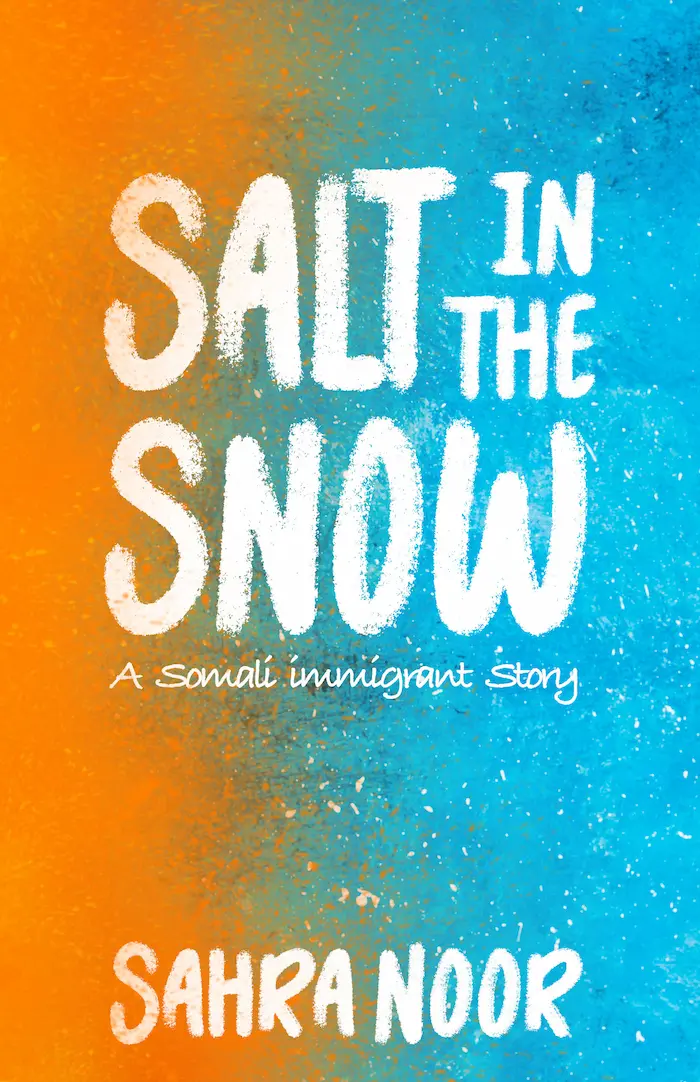
Salt in the Snow book cover by Sahra Noor

Available August 4, 2026 · Catalyst Press

Salt in the Snow book cover by Sahra Noor
Publication Information
Publisher

Catalyst Press

Publication Date

August 4, 2026

Language

English

ISBN-13

978-1960803511

About the book

Salt in the Snow

By Sahra Noor

From the sunlit courtyard of her family home in Mogadishu to the icy streets of Minneapolis, Salt in the Snow is a deeply personal memoir about migration, motherhood, and the enduring influence of a father's love.

Raised in a close-knit, multigenerational Somali household, Sahra was shaped early by tradition and by the towering presence of her father, Noor. His voice, his choices, and his values became the compass by which she learned to navigate the world.

When she arrived in the United States as a teenager, everything shifted. As Sahra built a life in America on her own terms, she examined how her father's hopes and expectations both shaped and confined her, and how the love between them, though complex, endured through every chapter of her life.

Told with fierce honesty, emotional clarity, and quiet resilience, Salt in the Snow is a memoir about searching for belonging in the in-between.

Early Praise & Features

Readers respond to Salt in the Snow

Early readers are calling Sahra Noor’s memoir a deeply human story of family, exile, resilience, and the bonds that carry across borders and generations.

Early-reader praise

“A story of perseverance in the face of adversity… a human story that has parallels and lessons for all of us.”

Michael Stoesz Educator, author of Walter Meets Mack: A Minnesota Adventure
Summer reads feature

Salt in the Snow featured in Mpls.St.Paul Magazine’s summer reads list

Mpls.St.Paul Magazine included Sahra Noor’s memoir in its 2026 guide to summer books with Minnesota connections.

Read the feature
Advance praise

“Graceful prose… a generosity of spirit… a book that should be read by all seeking to understand the complexities of life: country, race, history, complicated bonds and family.”

Sandra Kjarstad Bloom Author of Getting There
Star Tribune feature

The Star Tribune says Sahra Noor’s memoir promises “fierce honesty”

The Minnesota Star Tribune featured Salt in the Snow as local nonfiction covering Sahra’s life in Somalia and the United States.

Read the article
Read an Excerpt

Chapter One: Beginnings

A short excerpt from Salt in the Snow.

Pages 1-2
Excerpt

Chapter One: Beginnings

Beyond the white sand beaches, Mogadishu, the city of my birth, was a colorful place, a playground where every corner held a memory, a story, or a piece of who we were.

For centuries, men arrived in the city with salt drying at their collars, their sandals slapping softly against the sand. From Turkey, Persia, India, Oman, Yemen, and later Italy, they brought more than goods. They brought habits, prayers, new sounds, and ways of building and governing, sometimes in the form of colonization. They lingered, bartered, prayed, then disappeared into the city. Each wave changed the landscape a bit without undoing what came before, like hands working wet clay.

Mogadishu did not ask them to choose between what they brought and what they found. It absorbed them. New sounds folded into old ones. Spices shifted familiar meals by a shade or two. Buildings like the Cattedrale di Mogadiscio and the Arch of Umberto rose, unfamiliar at first, but not unwelcome. Nothing in the city felt fixed. Nothing felt fragile either.

My mother’s people had arrived this way, crossing the water from the Hadhramaut region of Yemen. By the time I knew them, their journey had faded into story, but the sea remained. It shaped how they stood, how they worked, how they spoke about responsibility. They became Benadiri Somalis, often called Reer Xamar, the people of Mogadishu, or Reer Maanyo, the people of the ocean. Their lives bent toward the sea, as merchants, fishers, and ship captains.

My maternal grandfather, Baba Abukar, carried this inheritance proudly. He was a ship captain, an expert navigator and, later, the head of marine transport for the country. He spoke of routes and tides with the certainty of someone who trusted water more than land. To him, the ocean was not a border. It was a system, mapped by lighthouses you could trust to guide you to shore.

I grew up among them in the Hodan neighborhood, in a large house just a short walk from Siigaale market. Although my parents Faduma and Noor owned a house in Howl Wadaag, they had chosen to move in with my mother’s family because they were two working parents and they knew there would always be someone around to lend a hand or keep a watchful eye on their children.

Inside our gate, the house moved in its own rhythm. Someone was always watching. Someone was always correcting. Someone was always laughing too loudly. I was taught how to read and write at four, by my uncle Abti Ma’ow, a journalist who smelled faintly of ink and paper. My hair was braided by my older sister, Awo, and my ears were pierced more than once by aunt Habaryar Farah, who requested permission only after the fact.

Our home felt like a self-contained small village. We lived in two four-bedroom houses, built side by side, that together held three generations – eighteen people in total. A single main gate connected the houses, opening into a shared courtyard that led to a sunken kitchen and dining area, where our days began and ended.

Morning announced itself before anyone spoke.

Just before five, the adhan from the Uunlaaye mosque lifted the dark, reminding us of Fajr, the first prayer of the day. After she prayed, my grandmother Ayeeyo Khadija lit frankincense, and the smoke slipped through our bedroom windows. Then came the aroma of qaxwo, coffee she brewed with cinnamon, cardamom, and ginger. That smell meant it was time to wake up.

By six, the house was already loud. Plates clattered. Tea steamed. A large Panasonic radiocassette that sat on a console table in the corner of the courtyard crackled loudly.

As I got ready for school, I stepped over sandals, uniforms, someone sleeping where they shouldn’t have been. I could hear someone shouting my name from the kitchen to feed me breakfast. Hooyo would run after me to straighten my shirt collar or correct my posture as I passed. A hand would catch my arm before I could run outside with uncombed or unbraided hair.

I walked to school with my neighborhood friends. We passed by vendors who shouted prices and women wearing bright colored diracs and guntiinos carrying a big basket without breaking stride. We learned to move quickly if a Vespa skimmed past too close, and to politely greet adults we made eye contact with.

As soon as we arrived at Dhagaxtuur Primary School, we lined up in the courtyard, eyes wandering but feet planted as the diritoor, our principal, called us to sing. First came the flag song, Calan suubanow samada u ekow, words we had memorized long before most of us could read. Then Guulwadow Siyaad, a song praising the president and his revolution, sung the same way we sang everything else; in unison, without much thought.

We knew the president’s face. His portraits were everywhere, hanging in classrooms and walls all over the city, often beside images of Marx or Lenin. Bold slogans framed them, promoting his version of “scientific” socialism: “Struggle and Progress.” “Unity, Socialism, Prosperity.” What we didn’t yet know was that he was a dictator, or that there was anything uneasy about the words rising so easily from our mouths. When the songs ended and the diritoor gave a short talk about manners, discipline or exams, we quickly filed into our classrooms.

I loved school. I studied hard, followed the rules, and always raised my hand first. Teachers praised me and my parents were proud of my progress, but some of my classmates called me a “show off.” Others were crueler. Their teasing stung more than I let on.

When I told my parents I wanted to fit in, to be accepted, to have more friends, they were firm. “Stay focused,” Hooyo would say. “I don’t send you to school to be popular. I send you to learn.” “Standing a little apart isn’t bad,” Aabe said matter-of-factly.

“Ignore them. As you grow older, you’ll learn to be okay with people not liking you.”

In Her Own Words

Sahra on Salt in the Snow

Sahra Noor reflects on the memories, choices, discoveries, and vulnerabilities that shaped her memoir.

Retailers

Order Your Copy

Salt in the Snow is available for paperback pre-order now. Kindle and digital editions will be available August 4, 2026, when the book officially publishes. Published by Catalyst Press.

Bookshop.org

Paperback $2046
  • Supports independent bookstores
  • A good choice for community-minded readers
  • Ebook format also available through Bookshop.org

Amazon

Paperback $2195
  • Preorders ship August 4, 2026
  • Convenient shipping and order tracking
  • Easy option for gifting or quick delivery

Amazon Kindle

Kindle Edition 12
  • Kindle preorders are not available yet
  • Digital edition available August 4, 2026
  • Read on Kindle devices or the Kindle app after publication
Coming Aug. 4, 2026
Salt in the Snow

Get the Book

A deeply personal memoir about migration, motherhood, belonging, and the enduring influence of a father’s love.

Choose Where to Buy